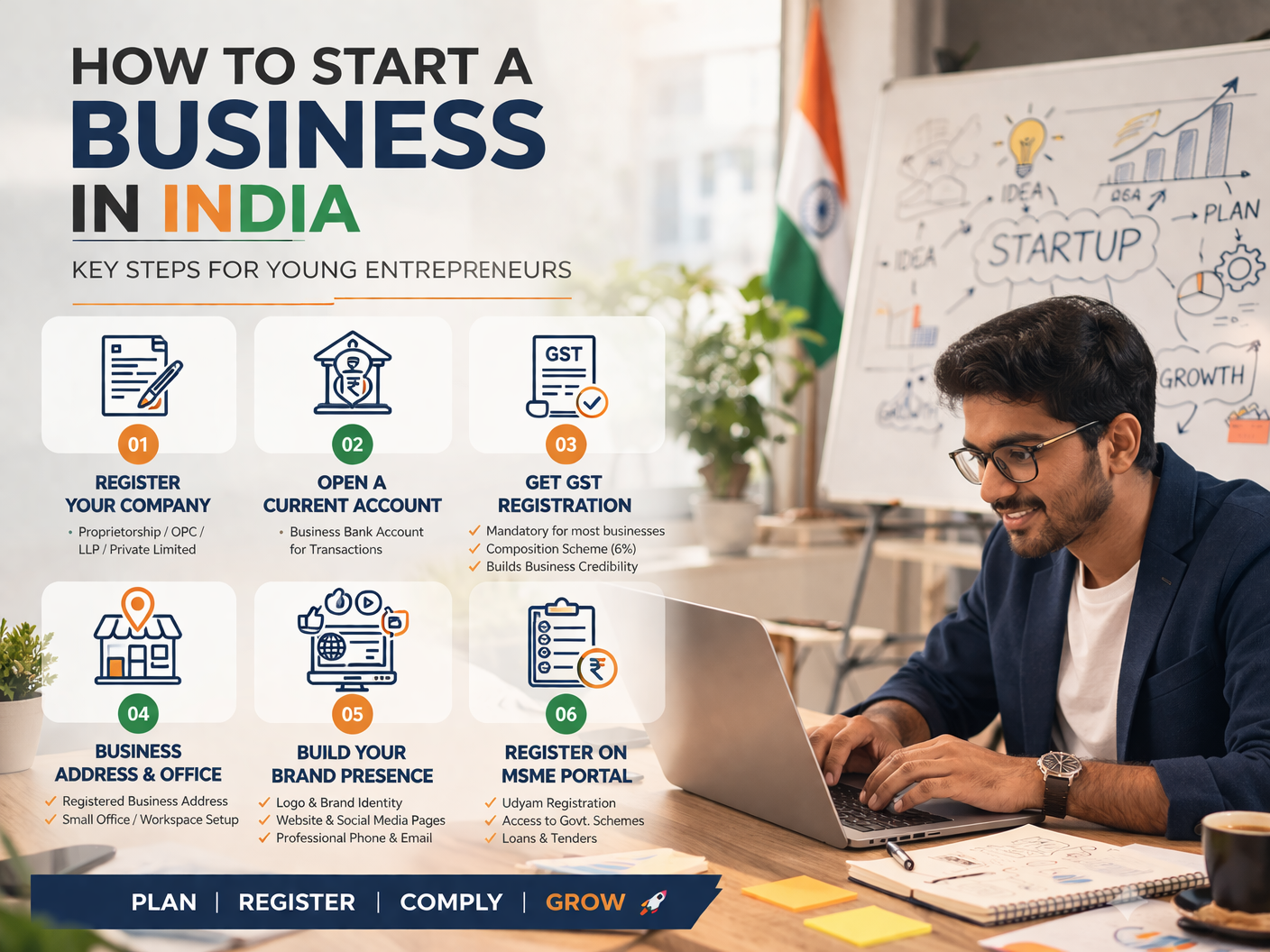
Starting a business in India today is both an opportunity and a responsibility. With a rapidly growing economy, increasing digital access, and strong policy support for entrepreneurship, the environment is more favorable than ever. However, many aspiring entrepreneurs begin with enthusiasm but lack clarity on the basic structure required to build a sustainable business. A business is not just an idea — it is a system that requires legal, financial, and operational discipline. Those who treat entrepreneurship seriously from the beginning are the ones who build long-term success.
The first and most important step is choosing the right form of business entity. In India, entrepreneurs can register as a sole proprietorship, One Person Company (OPC), Limited Liability Partnership (LLP), or a Private Limited Company under the Companies Act. The choice depends on the scale, nature, and long-term vision of the business. While a proprietorship is simple and suitable for small-scale operations, structured entities like LLPs and Private Limited Companies provide better credibility, scalability, and access to funding. A well-structured business not only builds trust but also opens doors to larger opportunities.
Once the entity is defined, establishing a proper financial system becomes essential. Opening a current account in the name of the business is a basic requirement to manage transactions, receive payments, and maintain transparency. Along with this, maintaining proper accounting records, generating invoices, and tracking cash flow are critical for sustainability. In today’s digital economy, businesses must adopt online payment systems and financial tools to operate efficiently. Financial discipline is the backbone of every successful enterprise.
Tax compliance is another key aspect that entrepreneurs must understand early. Goods and Services Tax (GST) registration depends on the nature and scale of the business. For service-based businesses, GST is generally required once turnover exceeds ₹20 lakhs, while for goods-based businesses, the threshold is ₹40 lakhs. However, even before reaching these limits, GST registration becomes important when dealing with other businesses, distributors, or corporate clients. The composition scheme offers a simplified tax structure for smaller businesses, but it comes with limitations. Understanding taxation is not just about compliance — it directly impacts pricing, margins, and business strategy.
Beyond legal and financial setup, building a business identity is equally important. A registered business address, basic office setup, and MSME (Udyam) registration provide legitimacy and access to government benefits. At the same time, creating a brand presence through a logo, website, and social media platforms is no longer optional. Even a simple one-page website and active digital presence can significantly enhance credibility. Entrepreneurs should also consider trademark registration to protect their brand identity in the long run. In today’s market, visibility and credibility go hand in hand.
Entrepreneurship is a continuous learning process, and no individual can master every aspect of business in isolation. This is where exposure, networking, and ecosystem support become critical. Platforms like YES 2026 (Young Entrepreneurs Summit) and initiatives under YES4Growth are designed to bridge this gap by offering workshops, seminars, and real-world insights into starting and scaling businesses. By connecting with experienced entrepreneurs, service providers, and industry experts, young founders can gain clarity and avoid common mistakes. The right guidance at the right time can accelerate a business journey by years.
Ultimately, starting a business in India is not just about registration and compliance — it is about building something meaningful and sustainable. With the right structure, discipline, and mindset, even a small idea can grow into a significant enterprise. The path may be complex, but it is accessible to those who are willing to learn, adapt, and take action. The journey of entrepreneurship begins with a decision — and the best time to take that decision is now.
By Mr Varaprasad (Jai) Singireddy, Founder and CEO, JAI Foundation.